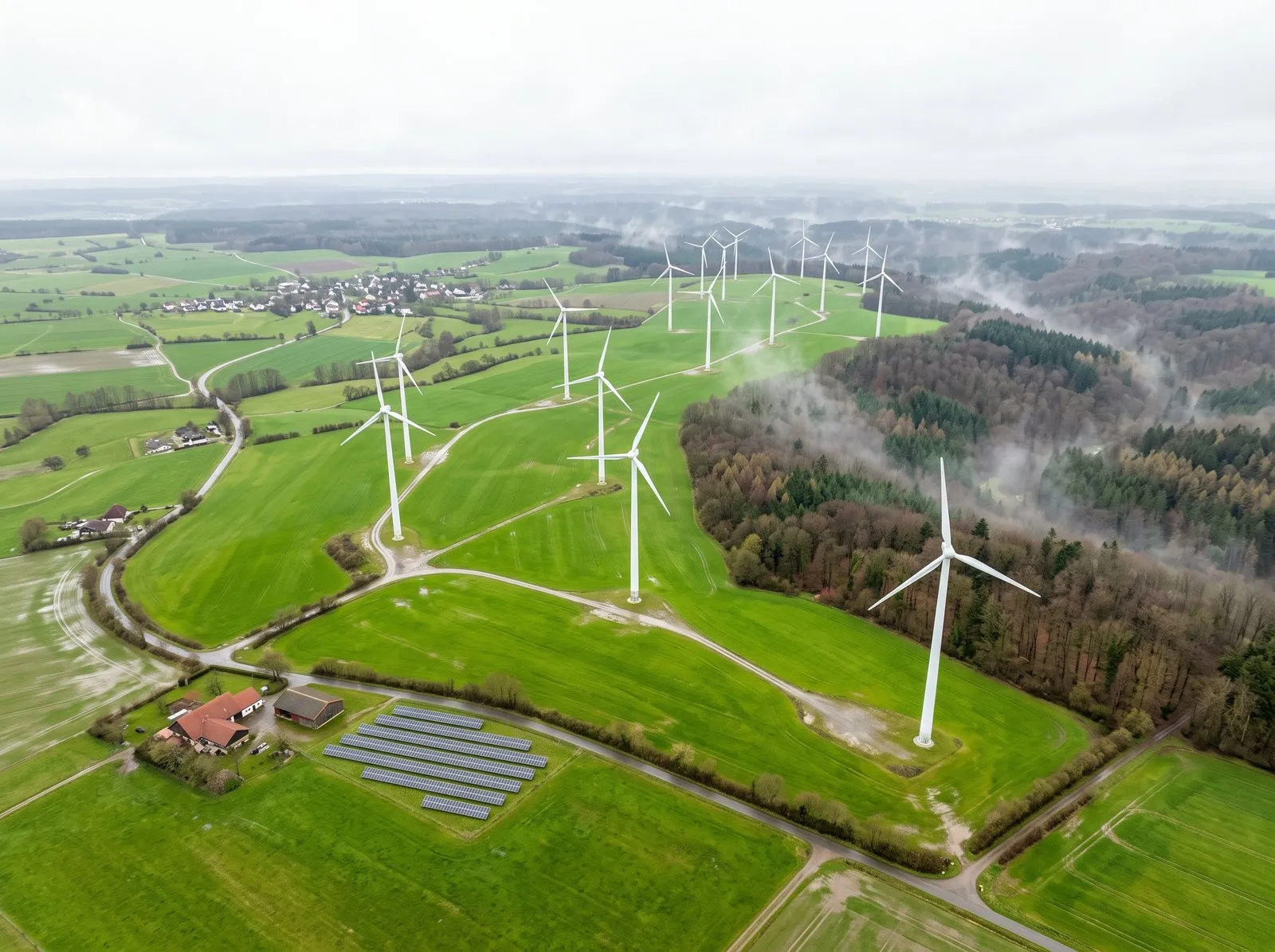
Grid integration means connecting and operating generation within an electricity system while respecting its technical requirements. For wind and solar, this involves changing production profiles, uncertainty and the location of generation relative to demand and network capability. Forecasting helps prepare for those conditions. It does not add transmission capacity or replace the engineering studies needed for a connection.
Planning and operations need different information
Long-term planning considers future capacity, demand, network development and representative weather conditions. Operational decisions concern the next scheduling intervals, available equipment and current network state. A forecast suitable for tomorrow's dispatch is not a complete dataset for a long-term reinforcement study, and a long-term scenario is not an operational forecast.
Define the geographic and electrical boundary. A national renewable total may support a broad system view while concealing a constraint at one substation. A local injection forecast can be more relevant to distribution operations. Aggregation should follow the decision, not simply the convenience of available data.
Variability and uncertainty are distinct
Variability is the change in production over time. Some changes are predictable, such as the broad solar day-night pattern. Uncertainty concerns the difference between what is forecast and what actually occurs. A system can prepare for a known ramp yet remain exposed to uncertainty in its timing or magnitude.
Evaluate both. A smooth average generation profile can understate the ramps that operations must manage. A single accuracy statistic can conceal rare but consequential deviations. Use time series and scenarios to inspect the conditions that matter to the operational process, while retaining clear summary metrics for repeatable comparisons.
Network location changes the consequence
Production and demand must be considered within the network's capabilities. More generation in one area is not interchangeable with the same generation elsewhere if a relevant connection is constrained. Forecasting can inform anticipated injections and help identify stress conditions, but determining a safe operating state requires the appropriate network model and engineering criteria.
Asset identifiers and network mapping are therefore important integration inputs. Record which plants belong to each region, feeder or other relevant grouping. Update that mapping when capacity changes. A statistically sound forecast aggregated using obsolete topology can answer the wrong operational question.
Flexibility must be available where and when needed
Storage, controllable demand, interconnection and other resources can help manage changing supply and demand. Their effect depends on power limits, energy limits, location, response time and availability. A battery with insufficient charging headroom cannot absorb a production peak merely because it is installed in the region.
Forecast scenarios can support tests of these constraints. Use coherent paths across time, since a sequence of errors can consume flexibility differently from isolated interval errors. Preserve dependence across renewable assets where shared weather drives their output. Otherwise, aggregation can create a misleading impression that all deviations cancel.
Curtailment and telemetry need explicit treatment
Measured renewable output may already include operational restrictions. If those observations train a forecast intended to describe available generation, the target is mismatched. Conversely, a forecast of unconstrained potential may be incomplete for scheduling actual injections. Maintain both concepts when the process needs them and document the link between them.
Telemetry quality is equally relevant. Missing readings, clock shifts and incorrect capacity records can look like production uncertainty. Carry quality flags into the forecast and the evaluation. A complete numerical series created by silently filling gaps is not necessarily a better operational input than one that clearly marks uncertainty about the underlying data.
Evaluate the forecast within a defined process
For a scheduling use case, replay forecasts at the original decision cutoffs and measure how they affect the specific process. For planning, test a range of resource and demand scenarios rather than relying on one favourable year. Keep forecast performance distinct from the performance of the network or flexibility strategy that consumes it.
Include a practical failure exercise during integration: delay an input, mark telemetry stale and replay a capacity change. Confirm that downstream users receive the intended flags and fallback. Operational clarity during degraded conditions is part of the forecast specification.
A practical integration specification states the target regions, interval definitions, revision schedule, data quality signals and fallback behaviour. It also names the engineering or operational model that uses the forecast. That makes the role of forecasting concrete: it supplies timely evidence about renewable injections, while the wider system determines how that evidence is turned into reliable operation.