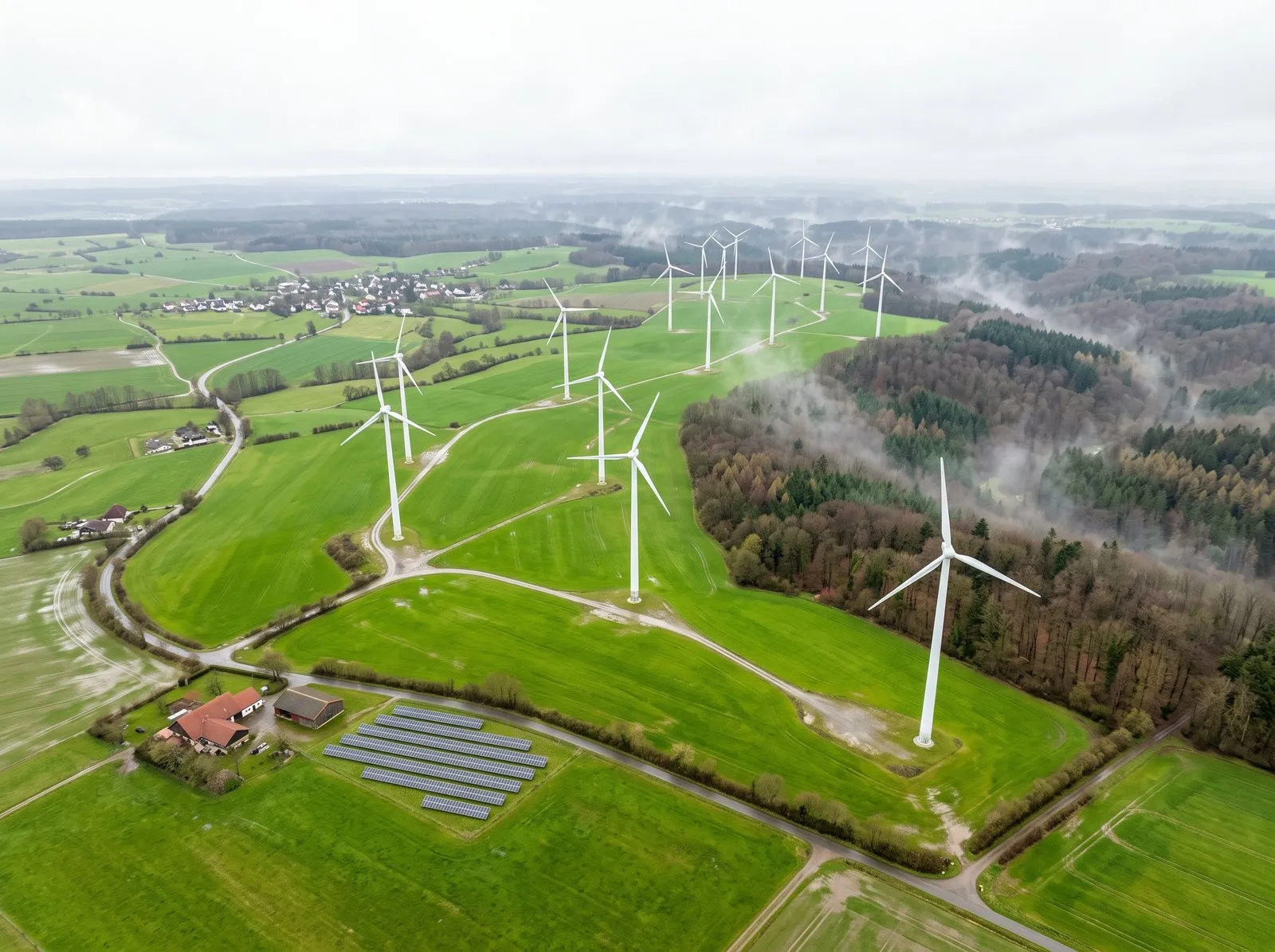
Renewable energy curtailment occurs when wind or solar production is deliberately limited below what the resource and available equipment could otherwise deliver. It differs from an equipment failure and from low output caused by weak wind or cloud. The distinction is essential for forecasting: a plant can have a good weather-based generation forecast and still export less electricity because its operating limit changed.
Why production is restricted
Physical network constraints can limit how much power can be transported from an area. System balancing needs, minimum operating levels of other resources or local export arrangements can also create situations in which available renewable output exceeds what can be accommodated. A plant may additionally follow commercial operating decisions, depending on its contracts and market context.
These causes require different evidence. A weather model cannot infer a plant instruction that has not yet been issued. A regional generation outlook can identify conditions associated with high production, but it does not alone determine which asset will be limited. Avoid treating a curtailment forecast as simply another name for a renewable power forecast.
Available power and metered output are different targets
An available-power estimate asks what the plant could produce without the relevant restriction, given its physical state and resource. A metered-output forecast asks what will appear at a defined measurement boundary. Both can be useful, but their difference needs an explanation. Plant availability, electrical losses and curtailment may all sit between them.
For a trader, expected export may be the scheduling target. For an operator investigating performance, available power may be necessary to estimate lost generation. For a grid team, regional unconstrained generation and constrained injections can answer different planning questions. Define the target before deciding which accuracy score is appropriate.
Curtailed data can mislead a model
Suppose a sunny PV plant repeatedly exports at a reduced limit. A statistical model trained only on weather and metered power may interpret that cap as normal plant behaviour. When the limit is removed, it may systematically underpredict output. A wind model can encounter the same problem when constrained operation distorts the observed power curve.
Retain setpoints, dispatch instructions, status flags and their timestamps where available. Do not silently discard every suspicious low reading or assume every flat section is curtailment. Classify uncertain periods explicitly and test how alternative classifications affect the result. Data cleaning should make the target clearer, not manufacture a favourable validation score.
Estimating lost generation is a separate analysis
The difference between an unconstrained estimate and actual output can support an assessment of curtailed energy. However, that estimate carries uncertainty. Weather forecast error, unavailable equipment and imperfect power conversion may also contribute to the gap. A defensible calculation states its counterfactual method and the evidence used to isolate the restriction.
Multiply interval power differences by interval duration to obtain energy, using aligned boundaries and consistent units. Avoid adding negative and positive discrepancies indiscriminately or presenting an uncertain counterfactual as a measured quantity. Financial consequences depend on contracts and market arrangements; there is no universal compensation or cost formula that follows from the energy difference alone.
Forecasting helps prepare for constrained conditions
Renewable forecasts can inform scheduling, flexibility needs and network studies. Storage, demand flexibility or operational coordination may help use energy that would otherwise be limited, but their effectiveness depends on location, timing and physical capability. A battery elsewhere in the network cannot automatically solve a local export constraint.
Model the decision with its actual limits. Check whether storage has charging headroom, whether a flexible load can respond and whether the constraint occurs at the same connection point. Use scenarios for uncertainty in both production and restrictions. A single deterministic trace can conceal the possibility that the planned flexibility is unavailable when needed.
Build an evaluation that preserves the distinction
Report forecast performance during unrestricted operation separately from performance against metered output during restrictions. Then assess whether known instructions were represented correctly. If future instructions were unknown, make that limitation visible rather than attributing every resulting error to weather.
The operational objective is a consistent record of resource, equipment status, instructions and actual export. With that record, curtailment becomes an identifiable part of the forecasting problem. Without it, an apparent accuracy issue can send teams toward weather-model changes when the real missing input is the plant's operating constraint.