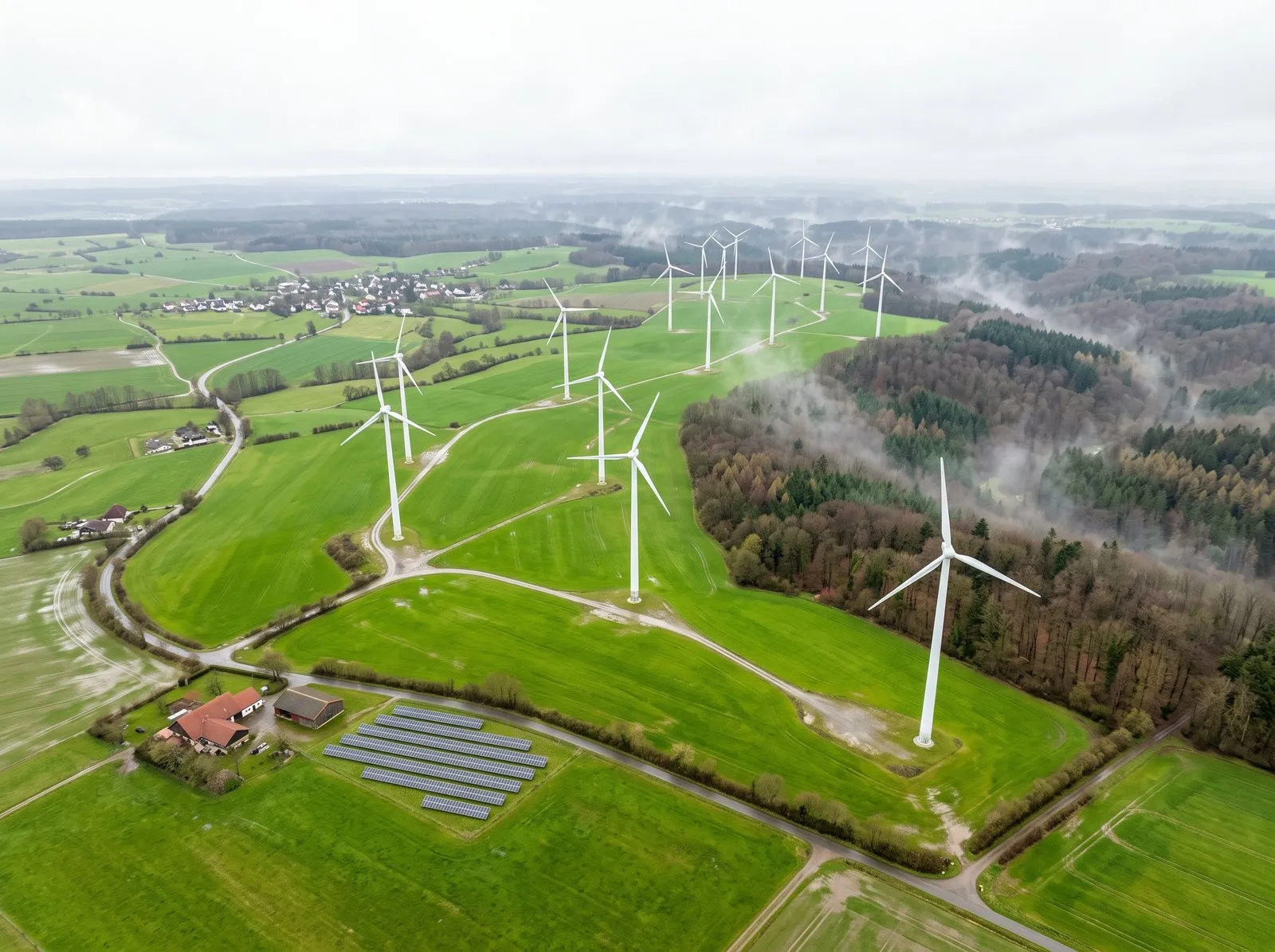
A power purchase agreement, or PPA, is a contract concerning the purchase and sale of electricity under agreed terms. It can support a project, a buyer's procurement strategy or both. The label alone does not describe how volumes, delivery, settlement or risk are allocated. Read those terms before deciding what a production forecast needs to provide.
Start with the electricity profile
Wind and solar production changes over time. An annual energy total does not describe the hours or intervals in which that energy arrives. Two projects with similar annual output can have different delivery profiles and different exposure when their production is compared with a buyer's consumption or a contracted schedule.
A forecast supports the expected short-term profile. A long-term energy assessment supports a different question: the expected production and uncertainty over a longer period. Neither should be substituted silently for the other. A projected annual yield is not a day-ahead schedule, while a good week-ahead forecast does not establish a project's long-term resource assessment.
Contract structures change the forecasting question
A contract tied to actual production differs from one that specifies a fixed or shaped delivery obligation. Physical and financially settled arrangements can also require different operational information. The specific contract determines who handles deviations, replacement purchases, scheduling and other obligations. There is no universal allocation that follows merely from calling an agreement a PPA.
For a forecasting scope, translate the contract into a target quantity and boundary. Identify the delivery point, settlement interval, nomination deadlines and treatment of losses or unavailable production. If several parties use the forecast, agree which version is the operational reference. Ambiguous ownership of revisions can create avoidable disputes even when the underlying forecast is sound.
Quantity risk and timing risk are distinct
Quantity risk concerns producing more or less energy than assumed or required. Timing risk concerns when that production occurs relative to demand, commitments or market conditions. A forecast can help anticipate these exposures, but it does not eliminate them. Weather variability and plant availability still matter, and contract terms decide their financial treatment.
A daily total can look correct while individual delivery intervals differ materially. Evaluate interval-level production forecasts at the horizons used for scheduling, then examine aggregate energy as a separate view. For a buyer concerned with matching consumption, test the relationship between the expected generation shape and its demand profile rather than relying on annual totals alone.
Separate weather from operational constraints
Actual export can differ from weather-based available generation because of outages, curtailment or connection limits. If a contract concerns delivered electricity, a forecast that assumes full availability may omit an important part of the target. If an assessment concerns the resource, constrained metered data may instead be an unsuitable training reference.
Retain equipment status and instruction records wherever possible. Record when each item was known, since a retrospective explanation is not the same as an input available before delivery. A forecast cannot represent an unexpected instruction perfectly if that instruction was not supplied or predictable. This limitation should be explicit in performance reporting.
Evaluate uncertainty at the right scale
Long-term exceedance values such as P50 or P90 require a stated convention, time period and uncertainty scope. Short-term probabilistic forecasts describe a different distribution. Do not interpret the same label as interchangeable across an annual project assessment and tomorrow's production intervals.
For a portfolio, consider the dependence between assets. Weather-driven errors can be shared across a region, so simply adding individually favourable estimates may misrepresent aggregate exposure. Scenario analysis should preserve relationships across time and sites when the contract or operating strategy depends on the combined delivery path.
A practical forecasting checklist
Ask which forecasts are needed before each contractual decision, who receives them and how revisions are recorded. Specify units, interval boundaries, issue times and quality flags. Test a backtest against measurements at the agreed delivery boundary, using the forecasts that were available at the time. Keep forecast accuracy separate from the commercial result of a particular contract.
Finally, have the relevant commercial and legal specialists interpret the actual agreement. Forecasting teams can make production assumptions transparent and testable, but they should not invent risk allocation, settlement rules or guaranteed savings. The useful output is a clear connection between the contract's delivery obligations and the data required to manage them.